


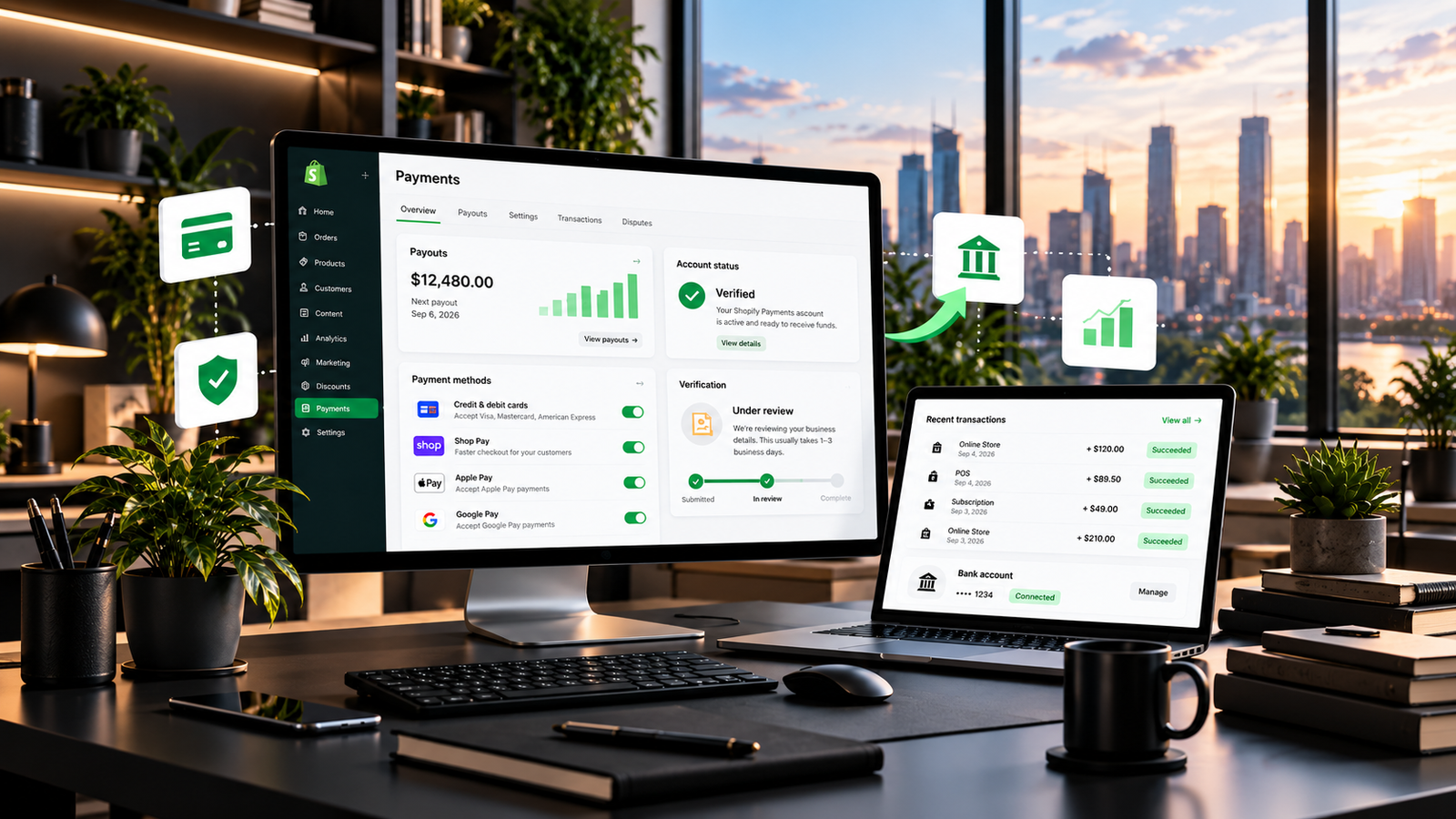
Choosing the right Shopify payment gateway affects much more than how customers enter their card details.
It can influence your checkout experience, transaction costs, available payment methods, currencies, payouts, international selling, and ultimately how easily customers can complete a purchase.
Shopify supports Shopify Payments as well as third-party and alternative payment methods, but the right setup depends on where your business operates, where your customers are located, and how your store works.
This is why simply choosing the first available payment provider is not always the best approach.
Shopify Payments vs Third-Party Payment Providers
Shopify Payments is Shopify’s integrated payment processing solution.
For eligible businesses, it allows payments and payouts to be managed within Shopify and removes Shopify’s additional third-party transaction fee on orders processed through Shopify Payments. Standard payment-processing fees still apply.
But Shopify Payments is not available to every business or in every country.
When it isn’t suitable or available, merchants may need to use a supported third-party payment provider.
Shopify also now allows certain eligible merchants to use Shopify Payments alongside a direct third-party provider, although additional fees and eligibility conditions can apply.
The important point is that a payment gateway should be selected based on the needs of the business rather than simply whether it can connect to Shopify.
Your Customers Should Influence the Decision
The best payment setup for a business selling mainly in the United States may be very different from one selling across Europe, the Middle East, or multiple international markets.
Customers often have preferred ways to pay.
Alongside cards, Shopify can support options such as accelerated checkouts and eligible local payment methods depending on the merchant’s setup and country.
In some regions, local payment methods can also appear according to the customer’s location and currency rather than only the merchant’s location.
This matters because checkout is the final stage of the buying journey.
A customer may like the product, trust the brand, and be ready to purchase—but still leave if they cannot use a payment method they expect.
For an international Shopify store, payment strategy should therefore be considered alongside market expansion, currencies, shipping, and localization.
Cost Is More Than the Provider’s Processing Fee
Merchants often compare payment gateways by looking only at the percentage charged per transaction.
That can be misleading.
Depending on the setup, there may be payment-processing fees, Shopify third-party transaction fees, currency conversion costs, payout considerations, refund implications, or additional provider charges.
For example, Shopify states that third-party transaction fees can apply when orders are processed through third-party providers, while transactions processed directly through Shopify Payments have a different fee structure.
A provider that appears cheaper at first may not necessarily create the lowest overall cost for the business.
The right comparison needs to consider the complete payment flow.
Payment Gateways Can Affect Checkout and Conversion
Payment infrastructure is also part of conversion optimization.
Adding every possible payment option does not automatically improve a store.
Too few suitable options can create friction, but an unnecessarily complicated setup can create its own problems.
Businesses should think about which payment methods their actual customers use, how quickly payouts are required, whether recurring payments are involved, which currencies need to be supported, and how the provider integrates with Shopify Checkout.
There can also be feature differences between providers.
For example, Shopify notes that some third-party integrations may not support every local payment method, subscription configuration, fraud feature, or Shopify service available through Shopify Payments.
This is why payment gateway selection should happen as part of the broader store architecture rather than being left until the end of development.
Why Payment Setup Becomes Complicated
Most merchants begin with a simple goal:
Accept payments from customers.
But the requirements can become more complicated as the business grows.
A store may expand into another country.
Customers may request additional payment methods.
The business may introduce subscriptions.
A provider may not support the desired currency.
Payout requirements may change.
Or the existing gateway may create unexpected fees or checkout limitations.
At that point, changing the payment setup without understanding how it affects the existing store can create new issues.
The correct solution may involve Shopify Payments, a third-party provider, local payment methods, or a combination of supported options.
There is no universal payment configuration that is right for every Shopify business.
Frequently Asked Questions
What is the best payment gateway for Shopify?
There is no single best gateway for every store. The right choice depends on your business location, customer markets, currencies, products, transaction costs, payment preferences, and technical requirements.
Do I have to use Shopify Payments?
No. Shopify supports third-party and additional payment methods where available. Shopify Payments is generally the most integrated option for eligible merchants, but it is not available in every situation.
Can Shopify Payments and another provider be used together?
In eligible configurations, Shopify Payments can operate alongside a direct third-party provider. Fees, supported functionality, and eligibility requirements should be reviewed before using this structure.
Why are customers abandoning checkout even though payments work?
Payment availability is only one possible reason. Customers may also leave because of unexpected costs, limited preferred payment methods, trust concerns, shipping issues, or other checkout friction. The complete checkout journey should be reviewed.
Need the Right Payment Setup for Your Shopify Store?
Choosing a Shopify payment gateway should not come down to trial and error.
The right setup needs to work with your business country, target markets, currencies, checkout, payment preferences, payouts, and long-term growth plans.
Aktive Online LLC helps Shopify businesses review their payment requirements, configure eligible payment solutions, troubleshoot payment issues, and build a checkout structure that fits how the business actually operates.
If you already have a gateway but are experiencing limitations, payout problems, unavailable payment methods, or international payment challenges, our team can review the existing setup and determine what needs attention.
Not sure which payment solution is right for your Shopify store? Book a free strategy call with Aktive Online LLC and let our team review your payment requirements.
Comments