


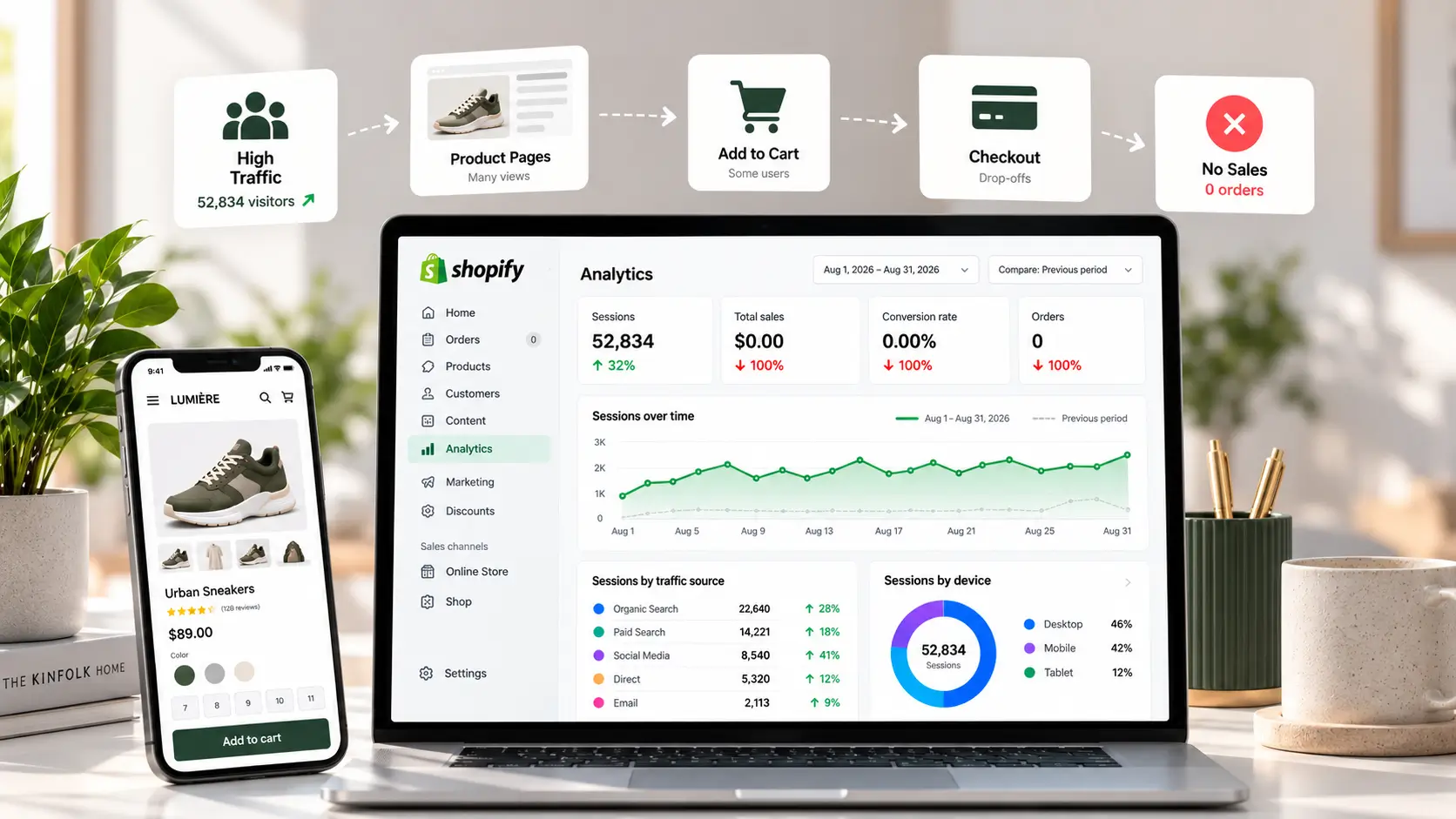
Getting traffic to your Shopify store but seeing few or no sales can be frustrating.
You may be running Meta Ads, Google Ads, posting on social media, or generating organic search traffic—and still not seeing enough customers complete a purchase.
When this happens, the problem is rarely just “not enough traffic.”
The real issue is usually somewhere between who is visiting the store, what they see when they arrive, and what stops them from completing the purchase.
That is why increasing your advertising budget is not always the right next move.
Traffic Quality Matters More Than Traffic Volume
Not every website visitor has the same value.
A store can receive thousands of visits from people who are unlikely to buy, while another store can generate more revenue from a much smaller but highly relevant audience.
If paid campaigns are targeting the wrong customers, keywords are too broad, or the messaging in the advertisement does not match the product page, traffic numbers may look healthy while sales remain low.
This is why the first question should not be:
“How can we get more visitors?”
It should be:
“Are we bringing the right visitors?”
If traffic quality is weak, changing the website alone may not solve the problem.
Your Product Page May Not Be Creating Enough Confidence
Once the right person reaches your store, the website needs to give them a reason to buy.
Customers may hesitate if product information is unclear, images do not show enough detail, the value of the product is difficult to understand, or important questions are left unanswered.
Trust also matters.
A first-time customer may want to understand delivery, returns, payment security, reviews, and whether the business itself looks legitimate before placing an order.
A product page can therefore look visually attractive and still fail to convert.
The real question is whether it gives customers enough confidence to move forward.
Pricing and the Offer Can Be the Real Problem
Sometimes the website is not the main issue.
The customer may simply not see enough value in the offer.
This can happen when pricing feels too high compared with alternatives, shipping costs reduce the perceived value, discounts are unclear, or the product does not appear differentiated from competitors.
Changing button colors or installing another Shopify app will not fix a weak offer.
This is why conversion problems need to be reviewed from a business perspective as well as a design perspective.
The store, pricing, product positioning, and customer expectations all work together.
Mobile Experience Can Lose Customers Quietly
A Shopify store may look polished on desktop while creating friction on mobile.
Buttons may be difficult to use.
Pop-ups may cover important information.
Product images may push essential content too far down the page.
Navigation may become confusing.
Or the checkout journey may simply require too much effort.
Because many customers discover products through mobile-first channels such as Instagram, Facebook, TikTok, and Google, these problems can directly affect paid campaign performance.
A responsive website is not automatically a good mobile shopping experience.
The entire journey needs to feel easy.
Checkout and Payment Issues Can Stop Ready-to-Buy Customers
A customer who reaches checkout has already shown strong intent.
Losing them at this stage can be particularly costly.
Unexpected shipping fees, limited payment options, unclear delivery expectations, account-creation requirements, or payment errors can all cause customers to abandon the purchase.
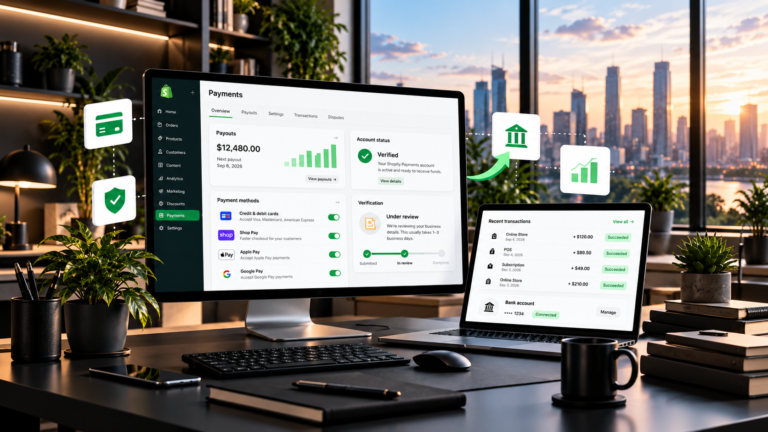
Payment setup can be especially important for stores selling internationally.
Customers may expect specific cards, wallets, currencies, or local payment methods.
If the checkout does not match how customers want to pay, even strong marketing and product pages may not be enough.
This is where Shopify development, checkout strategy, and payment configuration begin to overlap.
The Problem May Be Your Ads and Your Store Together
One of the biggest mistakes businesses make is looking at marketing and website performance separately.
The advertising team blames the website.
The development team blames the traffic.
The business owner keeps increasing the budget.
But the customer experiences everything as one journey.
They see an ad, click it, land on a page, evaluate the offer, explore the store, and decide whether to buy.
If any part of that journey feels disconnected, conversion can suffer.
For example, an advertisement may promise one thing while the landing page communicates something different.
Or the campaign may target customers who need more information than the product page provides.
This is why diagnosing low Shopify sales often requires reviewing both traffic acquisition and the website itself.
Don’t Start Fixing Things Until You Know the Problem
When a Shopify store is underperforming, it is easy to start making random changes.
Install another app.
Redesign the homepage.
Change the product page.
Offer a discount.
Increase ad spend.
Add more payment methods.
Any of these changes could help.
They could also make no difference because they do not address the real cause.
A better approach is to understand where customers are dropping out and what might be preventing them from moving to the next stage.
That requires looking at the business as a system rather than treating each symptom separately.
Frequently Asked Questions
Why am I getting Shopify traffic but no sales?
Possible causes include low-quality traffic, weak product positioning, poor trust, pricing issues, mobile UX problems, slow performance, checkout friction, payment limitations, or a mismatch between advertising and the landing experience.
Should I increase my ad budget if my Shopify store is not converting?
Usually not before understanding why the current traffic is not converting. Sending more paid traffic into the same problem can increase costs without improving results.
Does a Shopify redesign guarantee more sales?
No. A redesign can help when the existing website creates real conversion problems, but design alone cannot fix poor traffic, weak pricing, low demand, or an uncompetitive offer.
Getting Traffic but Still Not Enough Sales?
If your Shopify store is attracting visitors but not generating the sales you expected, the solution may not be one quick change.
The problem could be coming from your traffic, product pages, mobile experience, store performance, checkout, payments, offer—or several of these working against each other.
Aktive Online LLC can review the complete eCommerce journey to identify where potential customers are being lost and which areas actually need attention.
Because our team works across performance marketing, Shopify development, conversion optimization, and payment setup, we can look at the complete system instead of focusing on only one part of the problem.
Getting traffic but not enough sales? Book a free strategy call with Aktive Online LLC and let our team review what may be holding your Shopify store back.

Comments