


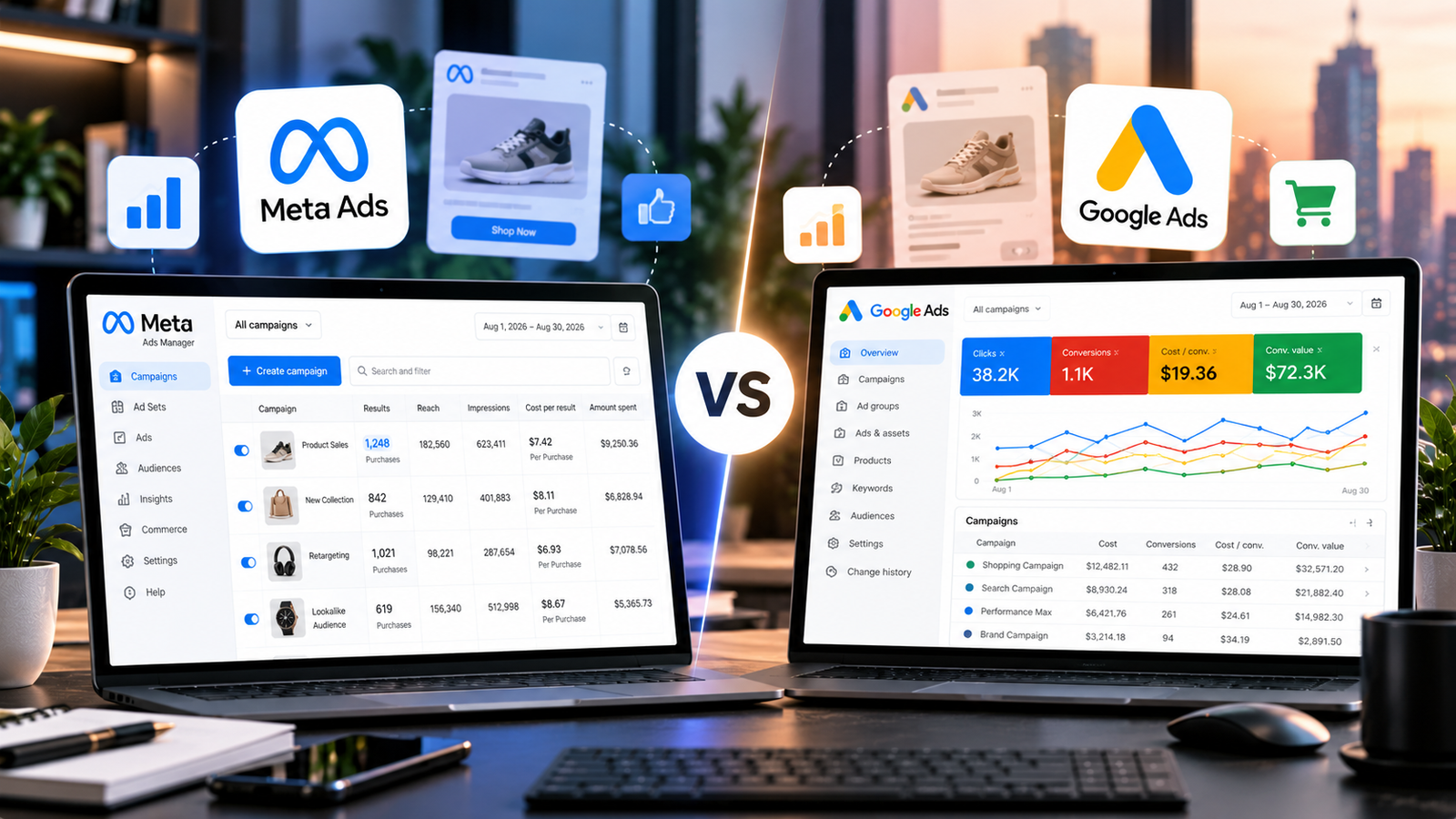
If you’re deciding between Meta Ads and Google Ads for eCommerce, the real question is not which advertising platform is better.
The question is where your customers are in the buying journey and which platform is more likely to reach them at the right moment.
Google Ads can help businesses appear when people are actively searching for products or solutions. Meta Ads can help brands reach potential customers while they are browsing Facebook and Instagram, even before they begin searching.
Both can generate sales. Both can also waste significant budget when the strategy, tracking, creative, targeting, or landing experience is wrong.
For most growing eCommerce businesses, choosing between Meta Ads and Google Ads should therefore begin with the business—not the advertising platform.
The Main Difference Between Meta Ads and Google Ads
Google is heavily connected to intent.
Someone searching for a specific product, comparing options, or looking for a solution is already showing some level of interest. Google Ads gives businesses several ways to reach these users, including Search, Shopping and Performance Max campaigns.
For retailers, Google’s Performance Max campaigns can distribute advertising across properties including Search, Shopping, YouTube, Display, Discover, Gmail and Maps while optimizing toward selected conversion goals.
Meta works differently.
People generally do not open Instagram or Facebook because they want to search for a product. Brands need to capture attention first.
That makes creative quality, messaging, product appeal, offers and audience understanding particularly important.
In simple terms:
Google often captures existing demand. Meta can help create and convert demand.
But that distinction alone is not enough to decide where your advertising budget should go.
When Google Ads Can Make More Sense
Google Ads can be particularly valuable when customers are already searching for what you sell.
Imagine someone searching for a specific product category, brand alternative, solution, or purchase-related phrase. A well-structured Google campaign can place your business in front of that customer during a high-intent moment.
For eCommerce businesses, product feeds also allow Google to connect products with Shopping and other retail advertising experiences. Google’s current retail advertising ecosystem includes Performance Max and Standard Shopping, with product reporting available across multiple campaign types.
However, search intent alone does not guarantee profitability.
The business still needs competitive pricing, strong product pages, accurate conversion tracking, suitable campaign structure, good product data, and a website capable of converting the traffic.
If those pieces are weak, increasing Google Ads spend can simply increase the amount of money being sent to an underperforming store.
When Meta Ads Can Be More Powerful
Meta Ads can be highly effective for products that need to be seen before people think about buying them.
This is especially relevant for visually appealing products, emerging brands, lifestyle products, products with a strong story, and offers that can quickly capture attention.
Instead of waiting for someone to search, Meta gives the brand an opportunity to introduce the product.
But this also makes the quality of the advertising strategy extremely important.
Two businesses selling similar products can get completely different results because one has stronger creative, clearer positioning, better offers, more convincing landing pages, or better campaign data.
This is why simply launching Facebook or Instagram ads and selecting an audience is not a complete performance marketing strategy.
The advertisement, audience, product, store experience and measurement setup all have to work together.
Should You Use Meta Ads or Google Ads?
For many eCommerce businesses, the best answer is eventually both.
A customer might discover your product through Instagram, visit your store, leave, search for your brand later on Google, see another advertisement, and then purchase.
Looking at Meta and Google as completely separate systems can therefore hide how customers actually move through the buying journey.
But that doesn’t mean every business should immediately split its budget across both platforms.
A smaller brand with limited advertising data may need to establish one profitable acquisition channel first. A mature eCommerce store may benefit from a broader strategy that uses different platforms for different stages of customer acquisition.
The right decision depends on factors such as your product, margins, average order value, existing demand, creative assets, website conversion rate, customer acquisition cost, previous campaign data and available advertising budget.
These are the numbers that matter more than simply asking which platform has cheaper clicks.
Why Ad Performance Is Often a Website Problem Too
One of the biggest mistakes businesses make is assuming poor advertising results always mean the ads are bad.
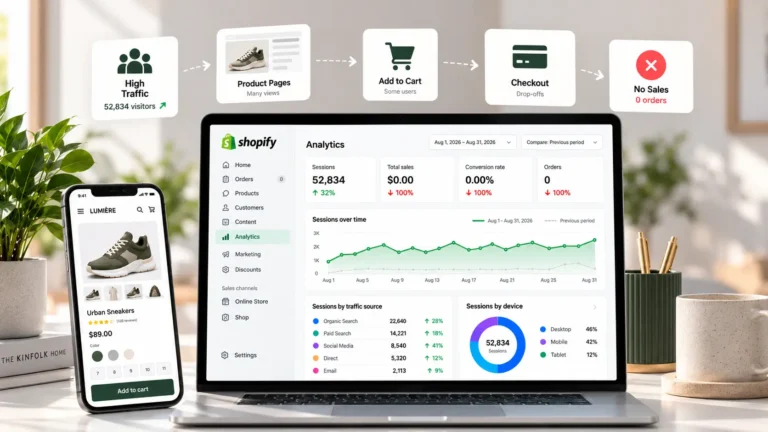
Sometimes the campaign is successfully bringing interested people to the website, but the store fails to convert them.
Slow pages, weak product presentation, unclear shipping information, poor mobile UX, missing trust signals, confusing navigation, limited payment options or a difficult checkout can turn good traffic into poor advertising results.
The opposite is also true.
An excellent store cannot compensate indefinitely for poor targeting, weak creative or incorrect campaign tracking.
Successful performance marketing requires the advertising and the website to operate as one system.
That is why Aktive Online approaches performance marketing alongside eCommerce development and conversion optimization rather than treating ad management as an isolated task.
Don’t Choose Based Only on ROAS Screenshots
ROAS is important, but it does not tell the entire story.
A campaign can show attractive platform-reported ROAS while the overall business is struggling with low margins, high return rates, weak repeat purchases or overlapping attribution between advertising channels.
Likewise, a campaign that appears weaker at first may be introducing large numbers of new customers who later purchase through another channel.
Google itself increasingly emphasizes conversion value and business goals when optimizing its automated campaign systems.
The goal should therefore not be to make one advertising dashboard look impressive.
The goal is profitable business growth.
Frequently Asked Questions
Is Google Ads better than Meta Ads for eCommerce?
Not universally. Google can be especially useful when strong search demand already exists, while Meta can be powerful for product discovery and creative-driven customer acquisition. The better platform depends on the business.
Should a new eCommerce store use both?
Not always. Splitting a limited budget across too many campaigns can make it harder to collect useful data and identify what is actually working. The right starting point depends on the product, budget and customer acquisition strategy.
Why are my Meta or Google Ads getting clicks but no sales?
The issue may be the advertising, but it can also be the store itself. Product positioning, pricing, page experience, trust, checkout, tracking and traffic quality should be reviewed together before increasing the budget.
Not Sure Where Your Ad Budget Should Go?
If you’re considering Meta Ads, Google Ads, or a combination of both, the decision should be based on your business data—not assumptions about which platform is currently more popular.
Aktive Online LLC can review your store, products, existing campaigns, conversion setup and growth goals to identify where the real opportunities and problems are.
Our performance marketing team works across paid acquisition and the eCommerce experience behind it, so we can look beyond ad clicks and focus on what ultimately matters: turning the right traffic into profitable customers.
Spending on ads without getting the results you expected, or planning your first serious eCommerce campaign? Book a free strategy call with Aktive Online LLC and let our team review the right direction for your business.

Comments