


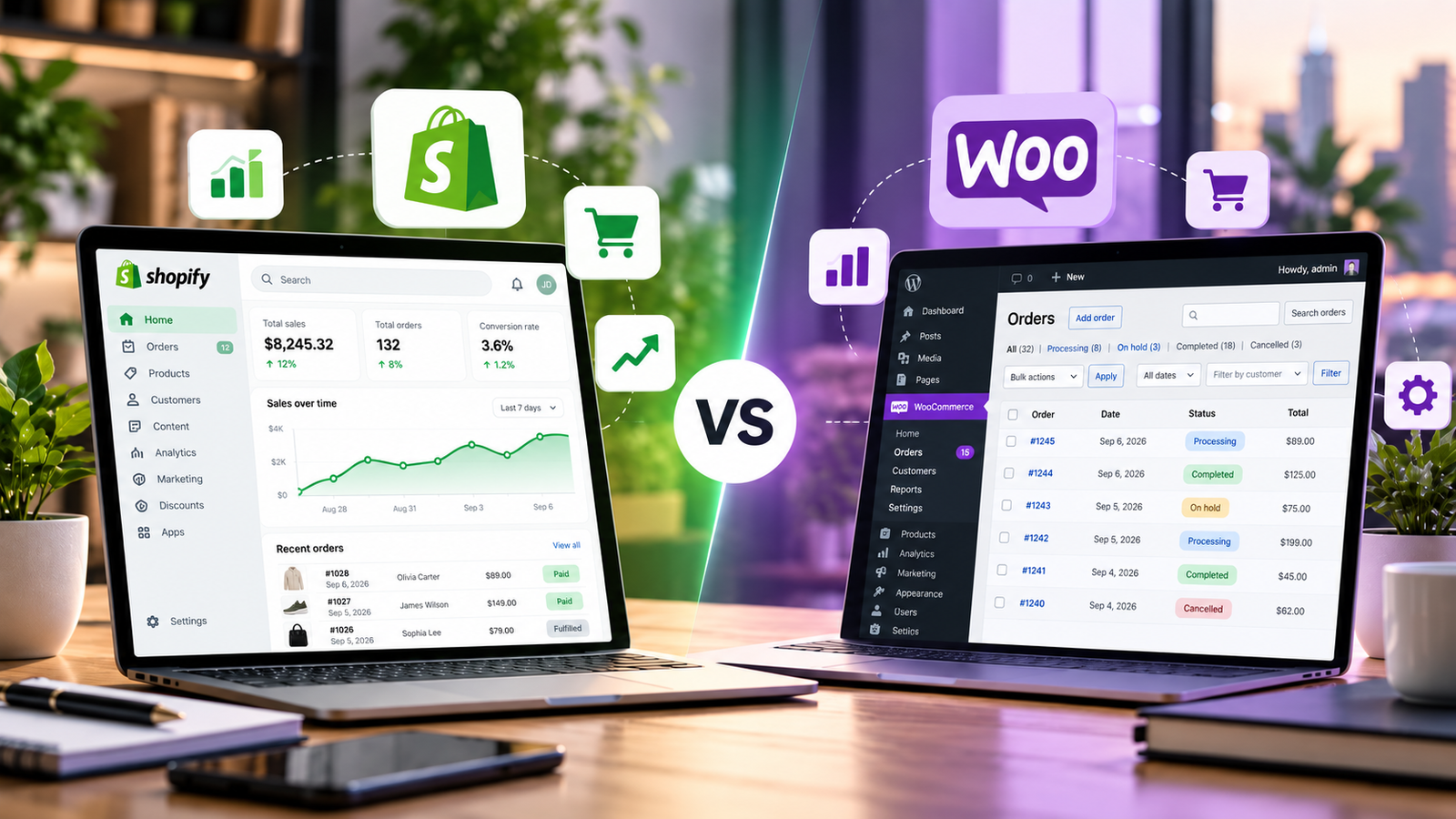
Choosing between Shopify and WooCommerce is one of the first major decisions when building or rebuilding an eCommerce store.
Both platforms can support successful online businesses, but they work very differently. Shopify provides a managed eCommerce environment where hosting, core infrastructure, security, checkout, and many store-management features are handled within one platform. WooCommerce is an open-source eCommerce solution built on WordPress, giving businesses much more control over their website, hosting, code, and integrations.
So, Shopify vs WooCommerce — which is better?
There is no universal winner.
The right choice depends on how your business operates, how much flexibility you need, how your store will grow, which payment options you require, and how much technical management you want behind the scenes.
That is also where many businesses make the wrong decision.
Shopify and WooCommerce Take Different Approaches
Shopify is designed as an all-in-one commerce platform.
Hosting is included, SSL is provided, updates to the core platform are managed for you, and most day-to-day eCommerce functions can be controlled from a single dashboard.
For many businesses, this means fewer technical decisions and a simpler operational setup.
WooCommerce takes a different approach.
Because WooCommerce runs on WordPress and is open source, businesses can choose their own hosting environment, customize the website deeply, modify functionality, and build around a much more flexible technical structure. However, hosting, maintenance, security, extensions, and performance also become part of the overall setup that needs to be managed.
Neither approach is automatically better.
The important question is which approach better supports your business model.
Where Businesses Often Choose the Wrong Platform
A common mistake is choosing Shopify simply because it appears easier.
Another is choosing WooCommerce because the core software is open source and assuming that automatically makes the entire store cheaper or better.
The platform itself is only one part of the decision.
A serious eCommerce business also needs to consider its design requirements, product structure, checkout experience, payment gateways, subscriptions, international selling, marketing integrations, website performance, ongoing maintenance, and future custom functionality.
For example, a relatively straightforward product business may benefit from Shopify’s managed environment.
A business that requires unusual product logic, advanced WordPress content functionality, deep custom integrations, or greater infrastructure control may find WooCommerce more appropriate.
But even these are not absolute rules.
The requirements of the individual business should determine the platform, not the popularity of the platform.
Shopify May Be Better When Simplicity Matters
Shopify can be an excellent choice when a business wants to focus primarily on selling rather than managing the technical infrastructure behind the store.
Its plans include hosting, and the platform provides an integrated commerce environment covering products, orders, checkout, analytics, payments, themes, and other core functionality. Shopify also manages much of the underlying platform maintenance.
This can make Shopify particularly attractive for businesses that want:
a cleaner management experience, faster deployment, less infrastructure responsibility, and an ecosystem built specifically around commerce.
But Shopify still needs professional planning.
Apps, theme customizations, payment configuration, conversion strategy, tracking, international setup, and poorly structured development can turn an apparently simple Shopify store into an expensive or difficult system later.
Choosing Shopify is not the same as having a well-built Shopify store.
WooCommerce May Be Better When Control Matters
WooCommerce can be particularly powerful when the business needs flexibility.
Because it operates within WordPress and uses an open-source model, developers can control far more of the technical environment and customize the store around specific requirements.
Hosting and infrastructure can also be selected according to the needs of the business rather than being bundled into one SaaS platform.
That flexibility is valuable, but it introduces responsibility.
Hosting quality, plugin compatibility, updates, backups, security, caching, database performance, and custom development can all affect the reliability of a WooCommerce store.
This means a properly engineered WooCommerce store can be extremely capable, while a poorly managed one can quickly become difficult to maintain.
The real question is not whether WooCommerce provides more control.
It does.
The question is whether your business needs that control and has the right technical structure to manage it.
What About Cost?
This is another area where simple comparisons can be misleading.
Shopify generally has predictable platform subscription costs, while additional expenses can come from themes, apps, payment processing, custom development, and other services. Shopify currently bundles hosting and SSL into its plans.
WooCommerce itself is open source, but running a professional WooCommerce store can involve hosting, premium extensions, security, maintenance, development, performance optimization, and other infrastructure costs. WooCommerce itself emphasizes that total costs depend heavily on how the store is hosted and maintained.
So comparing only the Shopify subscription against the price of the WooCommerce plugin does not give you the true cost of either platform.
The more useful question is:
What will this platform cost to build, operate, maintain, market, and scale for the next few years?
That answer is different for every business.
Shopify vs WooCommerce for SEO and Marketing
Both platforms can support strong SEO and digital marketing strategies.
The larger difference is often how the site is implemented.
A technically weak Shopify theme, excessive apps, poor navigation, thin category pages, or weak content can limit performance.
The same is true for WooCommerce when poor hosting, unnecessary plugins, technical problems, or an unstructured WordPress setup affect the user experience.
The platform does not create growth by itself.
Your store architecture, content, performance, conversion experience, analytics, paid marketing, and customer journey have a much greater impact on whether the website actually produces revenue.
That is why choosing between Shopify and WooCommerce should be part of a broader eCommerce growth strategy, not an isolated technical decision.
Which One Should You Choose?
If you want a simple answer, Shopify generally provides a more managed eCommerce environment, while WooCommerce provides greater technical freedom and control.
But a business planning a serious online store should go deeper than that.
Before choosing a platform, you should understand what your store needs today and what it is likely to need as it grows.
Your products, number of markets, payment requirements, subscriptions, integrations, marketing strategy, internal team, custom functionality, expected traffic, and long-term operating costs can all change the answer.
Migrating later because the wrong platform was chosen at the beginning can be considerably more complicated than making the correct decision before development starts.
Frequently Asked Questions
Is Shopify better than WooCommerce?
Not for every business. Shopify can be better for businesses that prefer a managed commerce environment, while WooCommerce can be better when deeper WordPress integration and technical control are important.
Is WooCommerce cheaper than Shopify?
Not necessarily. WooCommerce is open source, but a professional store can still require hosting, paid extensions, maintenance, security, optimization, and development. Shopify has a recurring platform subscription and may also require apps and development depending on the store.
Can a business move from WooCommerce to Shopify or Shopify to WooCommerce?
Yes, but migration can involve products, customers, orders, URLs, SEO data, integrations, redirects, design, and payment configuration. The complexity depends heavily on the existing store.
Not Sure Whether Shopify or WooCommerce Is Right for Your Business?
Choosing the platform is easy.
Choosing the right platform for your specific business model is where strategy matters.
At Aktive Online LLC, we work with both Shopify and WordPress/WooCommerce stores, which means our recommendation does not have to begin with forcing your business onto one particular platform.
We can review your products, functionality, payment requirements, growth plans, marketing needs, and existing infrastructure to determine which setup makes the most sense before development begins.
And if you already have a store that has become difficult to manage, slow, expensive, or restrictive, we can review whether the real problem is the platform itself or simply how the current store was built.
Planning a new eCommerce store or considering a platform change? Book a free strategy call with Aktive Online LLC and let our team help you determine the right direction before you invest in the build.


Comments