


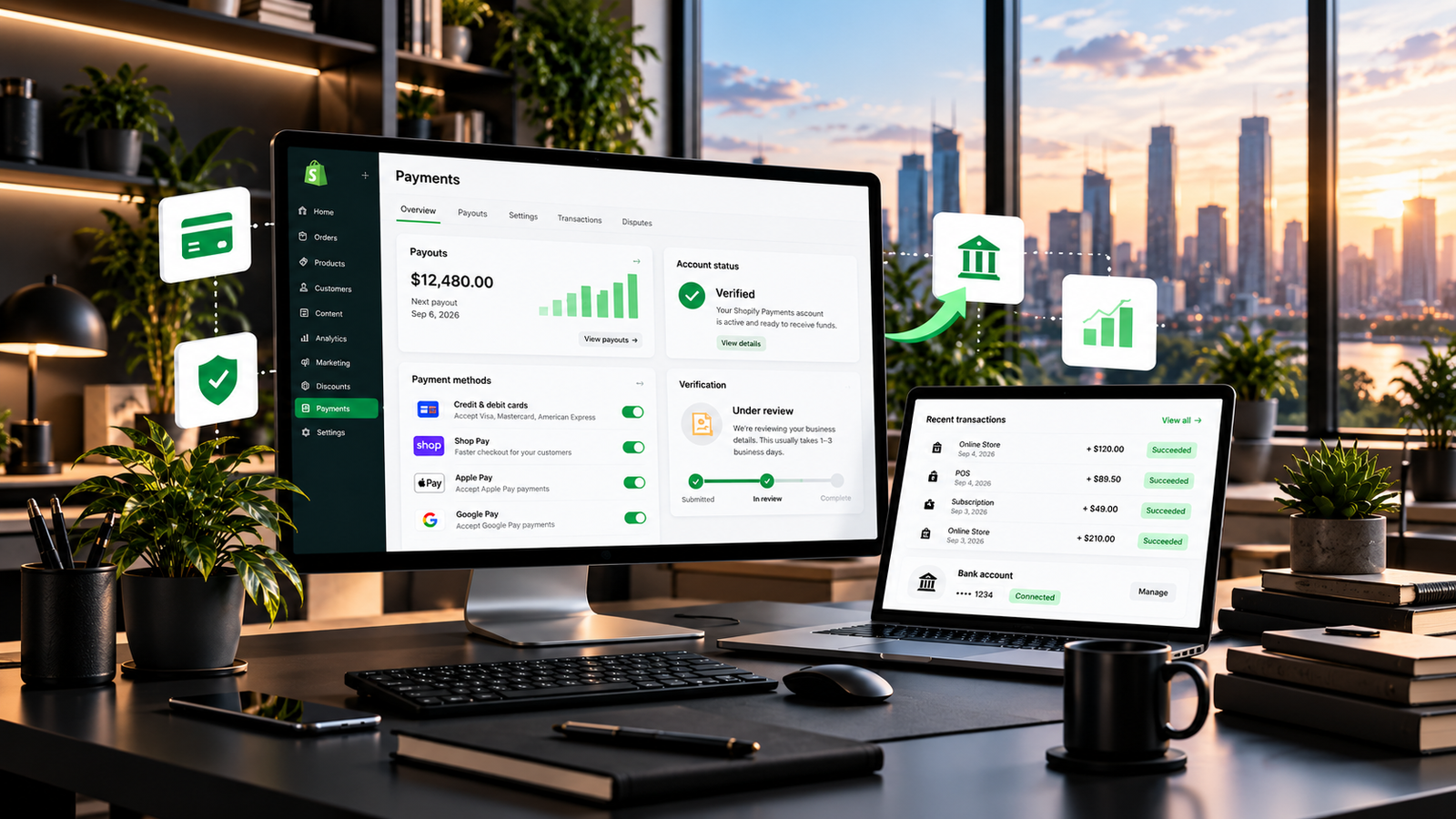
If you’re searching for help with Shopify Payments setup, chances are you’re either launching a new store or already dealing with a payment issue—verification delays, payout holds, rejected bank details, unavailable payment options, or an account that simply isn’t working the way you expected.
Shopify Payments can make payment processing much easier for eligible businesses, but the setup is not always straightforward. Your business location, company structure, store information, banking details, identity verification, product category, and account configuration can all affect whether Shopify Payments works smoothly.
And this is where many store owners get stuck.
The issue is often not one single setting. It is usually a combination of business information, payment configuration, verification requirements, and store setup that needs to be reviewed correctly.
Shopify Payments Setup Is More Than Just Activating a Button
Shopify Payments is Shopify’s integrated payment processing system. For eligible merchants, it allows payments, transactions, payouts, and supported payment methods to be managed directly inside Shopify.
On the surface, setup may look simple.
You open your Shopify payment settings, activate Shopify Payments, provide your information, connect a bank account, and complete verification.
But the important part is what information you provide and how your overall store and business setup aligns with Shopify’s requirements.
A small inconsistency between your company details, business address, ownership information, bank account, or identification documents can create verification problems. The same applies when a store’s business model or product category raises additional payment requirements.
That is why Shopify Payments setup should be treated as part of your store’s overall payment infrastructure, not just another Shopify setting.
Why Shopify Payments Problems Happen
Most Shopify Payments issues fall into a few common areas.
A merchant may discover that Shopify Payments is not available for their business location. Another store may activate it successfully but later receive a verification request. Some businesses can process orders but experience delayed or held payouts. Others run into problems connecting a bank account or enabling the payment methods they expected to use.
In many cases, store owners begin changing settings repeatedly without first identifying the actual cause.
That can make the situation harder.
Before making changes, the entire payment setup should be reviewed together—business eligibility, account information, verification status, banking configuration, store policies, products, checkout setup, and any alerts Shopify is displaying.
The right solution depends on the specific issue.
There is no single fix that works for every Shopify Payments account.
Verification and Payout Issues Need the Right Diagnosis
Verification is one of the most common areas where merchants need assistance.
Shopify and its payment partners may request additional information about the person operating the store, the business, its owners, the products being sold, or the bank account receiving payouts.
If the information submitted does not match the business records, additional checks may follow.
The same applies to payout holds.
A held payout does not automatically mean Shopify Payments has failed. It can be related to account verification, banking details, risk review, security requirements, or other account-specific factors.
What matters is identifying why the restriction exists before trying to fix it.
For example, replacing bank details will not solve a verification issue. Uploading additional documents will not solve a payment configuration problem. And changing business information unnecessarily can create new inconsistencies.
This is why proper diagnosis matters.
What If Shopify Payments Is Not Available?
Shopify Payments is not available for every country, business type, or situation.
That does not necessarily mean you cannot run your Shopify store.
Depending on your business location and requirements, there may be other supported payment providers or payment structures available.
But choosing a payment provider should not be based only on whether it can be connected to Shopify.
You also need to consider your customer locations, currencies, transaction costs, payout process, supported payment methods, checkout experience, and whether the provider is suitable for your type of business.
The wrong payment setup can create unnecessary fees, checkout friction, payout complications, and problems later as the store grows.
The goal should be to build a payment structure that works for the business long term—not simply to get one payment method activated today.
Why Professional Shopify Payments Setup Matters
Your payment system sits directly between a customer wanting to buy and your business receiving revenue.
That makes it one of the most important technical parts of an eCommerce store.
A proper Shopify Payments setup should consider more than activation. It should look at eligibility, verification readiness, banking configuration, checkout experience, available payment methods, store information, and how all of these pieces work together.
For an established store, the focus may instead be troubleshooting an existing problem without disrupting orders or payouts.
For a new store, getting the structure right from the beginning can prevent unnecessary issues later.
And when Shopify Payments is not the best option, the business may need a different payment solution altogether.
Common Shopify Payments Questions
Why is my Shopify Payments verification still pending?
Shopify may require additional information to verify your identity, business, ownership, products, or other account details. The correct next step depends on what Shopify is specifically requesting and whether the information already submitted is consistent.
Why is my Shopify payout on hold?
Payouts can be held for different reasons, including additional verification, account reviews, banking issues, or security requirements. The exact cause should be identified before changes are made.
Why is Shopify Payments not showing on my store?
Availability can depend on your business country, business type, store configuration, and Shopify Payments eligibility. If it is not available, another supported payment provider may need to be considered.
Can Shopify Payments approval be guaranteed?
No legitimate agency can guarantee Shopify Payments approval. Final eligibility and approval are controlled by Shopify and its payment partners. What a specialist can do is make sure the setup is handled correctly, identify problems, and help determine the most suitable payment solution for the business.
Need Help With Shopify Payments?
If your Shopify Payments setup is incomplete, verification is pending, payouts are on hold, your bank account is being rejected, or you simply want the payment system configured correctly before launching, this is exactly where Aktive Online LLC can help.
Our team works with Shopify stores to review payment configurations, identify setup problems, troubleshoot technical issues, configure eligible payment options, and help businesses choose the right payment structure for their store.
Instead of repeatedly changing settings and hoping the issue disappears, we can review the complete situation and determine what needs to be addressed.
Have a Shopify Payments problem or need help setting it up correctly? Book a free strategy call with Aktive Online LLC and let our team review your payment setup.
Shopify Payments eligibility, verification, and approval are ultimately determined by Shopify and its payment partners. Aktive Online LLC assists with legitimate setup, configuration, and troubleshooting and does not bypass Shopify, banking, or regulatory requirements.
Comments